8 min read
Framer SEO
How to Track Keyword Rankings for Your Framer Site
Framer Analytics shows visitors, not rankings. Track keyword positions and Search Console data without leaving the Framer editor.

Team 7 Seers
How to Track Keyword Rankings for Your Framer Site
Framer Analytics tells you how many people visited your site. Google Search Console tells you what queries your site received impressions for. Neither tool is inside your Framer editor, and neither gives you a focused view of the specific keywords you are actively targeting, how they are ranking, whether positions are improving, and which pages need further optimization.
This is the keyword tracking gap for Framer site owners. You can see traffic. You can see aggregate search performance. But unless you have a curated list of target keywords with position history tracking, you are essentially guessing whether your SEO work is having any effect.
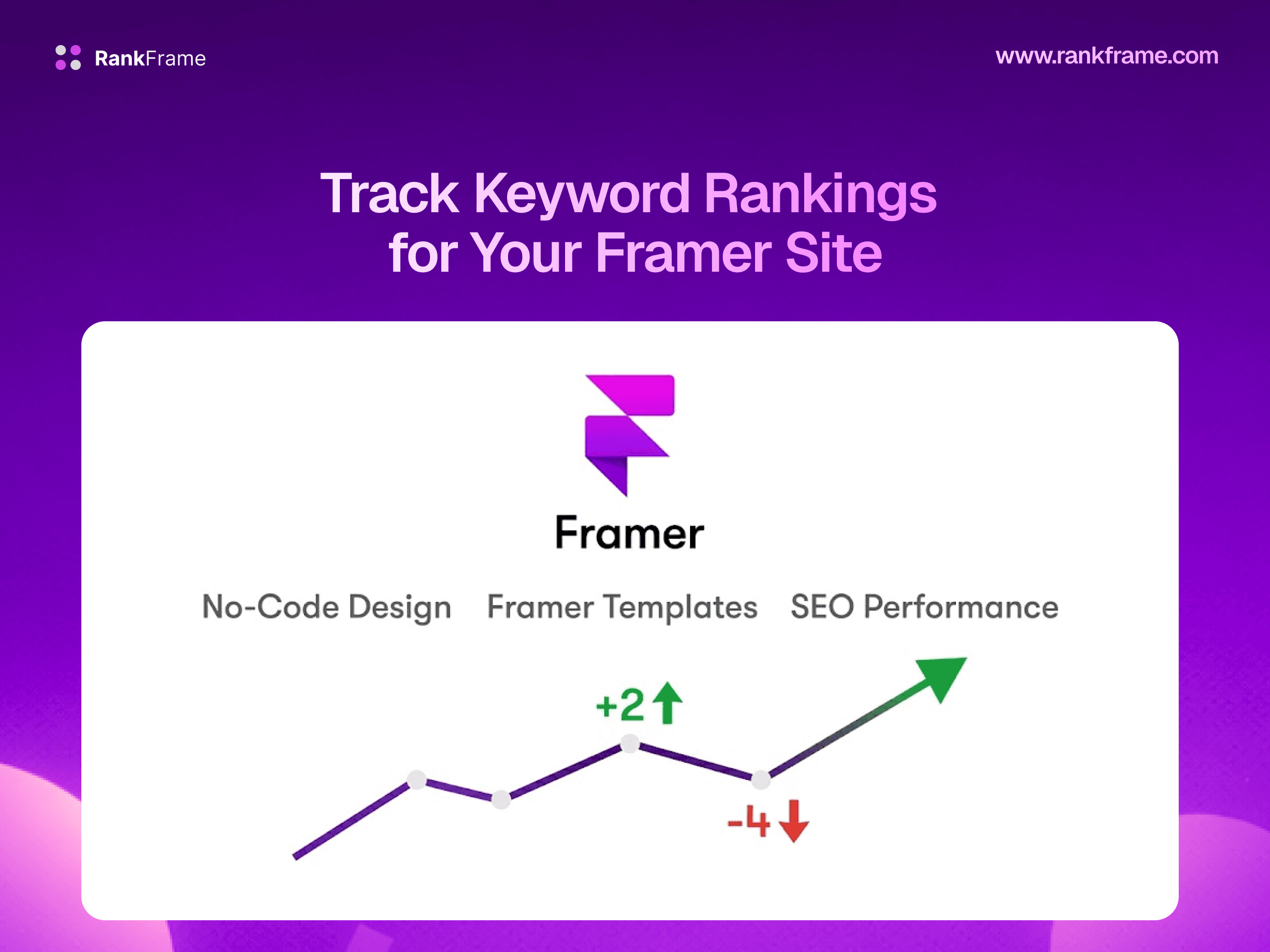
RankFrame's Keyword Tracker closes this gap by pulling data from Google Search Console and surfacing curated keyword position data, with sparkline history and change indicators, directly inside the Framer editor. This guide explains why keyword tracking matters, how the three tools in a typical Framer SEO stack differ from each other, how RankFrame's tracker works in practice, and how to build a research-to-monitoring workflow that tells you exactly whether your pages are climbing in search rankings.
The Tracking Gap in Framer's Toolset
Framer's native toolset handles the technical side of SEO well. The platform auto-generates a sitemap, creates canonical tags, handles robots.txt, and provides clean, fast hosting infrastructure. What Framer does not provide is any way to monitor the outcome of SEO work in terms of search rankings.
Consider a realistic scenario: you are a Framer developer who has optimized a SaaS landing page for the keyword "project management tool for designers." You have added a strong title tag, written a focused meta description, added schema markup, fixed all image alt text, and ensured the page has a clean heading structure. You publish the page and wait.
Two weeks later, you open Framer Analytics. Visitors are up slightly. Pageviews are steady. You cannot tell whether the page is ranking for your target keyword, whether you are at position 34 or position 8, or whether the optimization moved the needle at all. You would need to open Google Search Console in a separate browser tab, filter by the page URL, sort by query, and find the keyword manually. Then you would need to remember what position you were at before making changes, which you likely did not record.
This is the workflow RankFrame's Keyword Tracker replaces. You add your target keywords once. The tracker shows you position, impressions, clicks, and position history every time you open the plugin. No browser tab switching, no manual GSC filtering, no trying to remember your baseline.
Ranking Without Tracking Is Guessing
SEO optimization without position tracking is like exercising without ever stepping on a scale. You are putting in the work but have no objective measure of whether it is working. Position tracking turns SEO from an act of faith into a measurable, iterative process.
Why Keyword Tracking Matters for Framer Sites
Keyword tracking serves several distinct functions in a Framer site's SEO workflow. Each function addresses a different information need that neither Framer Analytics nor a quick glance at Google Search Console can satisfy.
Confirming That Optimizations Are Working
When you update a page's title tag, expand thin content, add internal links, or fix schema markup, you want to know whether those changes moved the keyword ranking. Position tracking with a history log gives you this confirmation. If your target keyword was at position 22 before the update and is now at position 14 two weeks later, the tracking record makes that improvement visible and attributable.
Identifying Ranking Opportunities
Pages ranking in positions 8 to 20 are in the zone where additional optimization often yields significant traffic gains. A page at position 8 for a high-volume keyword might only need an improved title tag, a more compelling meta description, and three additional internal links to move to position 3. Without tracking, you do not know which pages are in this opportunity zone. With tracking, those pages surface clearly.
Detecting Ranking Drops Before They Become Traffic Losses
Keyword rankings can drop suddenly after a Google algorithm update, after a site redesign, or after an accidental change to a page's title or canonical tag. Position tracking with sparkline history makes these drops visible immediately, often before they have had time to cause significant traffic loss. Early detection means early remediation.
Understanding What Drives Impressions vs. Clicks
The combination of impressions, clicks, and position data in the keyword tracker tells you more than just where you rank. A keyword with high impressions but very low clicks at position 4 suggests a title tag and meta description that are not compelling enough to earn clicks at that position. This insight drives specific copywriting improvements that traffic data alone would never surface.
Framer Analytics vs. Google Search Console vs. Keyword Tracking
These three tools show fundamentally different things. Understanding what each one is for prevents the confusion of looking for information in the wrong place.
How RankFrame's Keyword Tracker Works
The Keyword Tracker is located in RankFrame's Submit Indexing section. Here is a precise description of every element you will encounter when using it.
Adding Keywords
You can add keywords to the tracker individually or as a comma-separated batch. For a new site or a new tracking campaign, the comma-separated batch input is the fastest way to populate your list. Type your keywords separated by commas ("framer seo plugin, framer alt text, framer keyword tracker"), click Add, and all three will appear in the table simultaneously.
For detailed instructions on adding keywords, see the Adding Keywords to Tracker guide.
The Keyword Table
Once keywords are added, they appear in a table with the following columns:
Keyword: The search query you are tracking.
Impressions: The number of times your site appeared in search results for this keyword in the tracked period. High impressions with low clicks indicate a CTR problem (weak title or meta description at the current position).
Clicks: The number of times users clicked your search result for this keyword. Low clicks relative to impressions at a high position (1-3) is a strong signal to rewrite your title and meta description.
Search Position: Your average ranking position for this keyword. Remember: lower is better. Position 1 is the top of page one. Position 11 is the first result on page two.
Position History: A sparkline chart showing how position has changed over the tracking period.
The Position Change Indicator
Next to the search position number, RankFrame displays a change indicator. A green upward arrow with a delta value (for example, "2.4 up 0.3") means the keyword's average position improved by 0.3 positions since the previous data point. A downward arrow in red with a delta indicates a position decline. No arrow means no significant change.
Because search position is measured as a rank number, "up 0.3" means the position number decreased by 0.3 (for example, from 7.2 to 6.9). This is a ranking improvement. The green up arrow indicates better rankings, even though the position number is going down.
The 48-to-72 Hour Data Lag
Google Search Console data has an inherent lag of 48 to 72 hours. This means the position data in RankFrame's tracker is always showing you where you ranked 2 to 3 days ago, not your live ranking at this moment. This lag is built into the GSC API and affects every tool that reads from it. It does not indicate a problem with RankFrame; it is the nature of how GSC data is refreshed.
For practical tracking purposes, this lag is irrelevant. Keyword rankings change gradually. Meaningful position movements happen over days and weeks, not hours. The 48-to-72 hour lag does not impair your ability to make informed optimization decisions based on the tracker data.
For a full reference on the keyword tracker's capabilities and setup, see the Keyword Tracker Overview.
Keyword Research Plus Tracking: The Full Loop
The most effective keyword SEO workflow is a closed loop: research a keyword, optimize a page for it, add it to the tracker, and monitor whether the page is climbing for that keyword. RankFrame supports the full loop from a single plugin.
Step 1: Research Keywords with the Keywords Tab
RankFrame's Global Settings Keywords tab is a keyword research tool that pulls Search Volume, Keyword Difficulty (KD), Competition level, and Cost Per Click (CPC) for any keyword you enter. This data gives you the information you need to make informed targeting decisions before you invest time in page optimization.
Step 2: Assign Keywords to Pages
In the Keywords tab, you can assign researched keywords to specific pages in your Framer project. This creates an explicit target assignment: "this page is being optimized for this keyword." The assignment also enables the Focus Keyword Script toggle, which activates on-page focus keyword analysis for the assigned page.
Step 3: Optimize the Page
With a keyword assigned, run the per-page SEO audit in RankFrame to check whether the page is currently optimized for the target keyword. Key optimization points include the title tag (target keyword should appear near the start), meta description (target keyword should appear naturally), H1 heading (target keyword or close variant), page body text (keyword should appear in the first paragraph and several times throughout), image alt text (at least one image should reference the keyword context), and internal links from related pages using keyword-rich anchor text.
Step 4: Add the Keyword to the Tracker
Once the page is optimized and published, add the target keyword to the Keyword Tracker. This establishes your tracking baseline. Note the current position in your own records so you have a clear before-and-after reference point when you review progress in three to four weeks.
Step 5: Monitor Position Improvement Week Over Week
Check the Keyword Tracker each week. Look for keywords where the sparkline is trending in the improving direction and the position change indicator shows a green upward arrow. These are your wins. Look also for keywords where position is flat or declining. Flat keywords at positions 8 to 20 often benefit from content expansion, more internal links, or improved title and meta description writing. Declining keywords need immediate investigation: check whether the page was recently changed, whether the canonical tag is still correct, and whether a competitor has recently published stronger content.
How Many Keywords Should You Track?
The answer depends on your site's size and the complexity of your keyword strategy, but a focused list almost always outperforms a sprawling one.
For a Single-Product SaaS Site (5-10 pages)
Track 10 to 15 keywords. One primary keyword per major page plus two secondary keywords per page is a reasonable starting list. For a site with 5 core pages (home, product, pricing, blog, about), that is 15 keywords maximum. Each keyword in the list has a clear owner page and a clear optimization rationale.
For a Multi-Service Agency Site (10-20 pages)
Track 20 to 30 keywords. One primary keyword per service page, one per location page if applicable, and one per top-performing blog post. Keep the total under 30 to maintain focus and make the tracker actionable rather than overwhelming.
For a Framer Blog or Content Site (50+ pages)
Track 30 to 50 keywords for your most important content pages. Focus on pages that are in positions 8 to 20 (high opportunity) and your top 10 currently ranking pages (protect and improve). Do not attempt to track every page's keyword; instead, review your top pages in GSC quarterly and add new keywords to the tracker when you publish new optimized content.
Quality Over Quantity
Twenty well-chosen keywords that you review weekly and act on will drive more SEO progress than 200 keywords that you never have time to investigate. The value of keyword tracking comes from the action it enables, not from the number of keywords in the list.
Reading Sparkline Patterns
Sparklines are small inline charts. Without knowing how to interpret them in the context of position tracking, they can be misleading. Here is how to read the three common patterns you will encounter.
What to Do When You Spot a Problem Pattern
A keyword showing an upward (worsening) sparkline should trigger an immediate investigation workflow:
Check whether the page's title tag, meta description, or H1 was recently changed. Framer site updates can accidentally modify these if a designer edits a shared text component.
Check the page's canonical tag in the RankFrame per-page audit. A canonical pointing to the wrong URL will cause the page to lose all its ranking signals.
Check whether the page is still being indexed. Look for accidental noindex tags in the Advanced SEO audit section.
Review the keyword in Google Search Console directly to see the full position history and whether the drop correlates with a known algorithm update date.
Review the top-ranking competitors for the keyword. If a competitor recently published a more comprehensive page on the topic, you may need to expand your content to compete.
Patience Is Part of the Process
Keyword position improvements happen on a timeline of weeks to months, not hours. After optimizing a page, add the target keyword to the tracker and give it at least three to four weeks before drawing conclusions. Google needs time to re-crawl the page, evaluate the changes, and update its ranking assessment. Checking for results daily leads to anxiety without insight. Weekly reviews are the right cadence.
Frequently asked questions
Does Framer have built-in keyword tracking?
No. Framer Analytics shows visitor counts, pageviews, and bounce rate but has no keyword tracking or search position monitoring.